Model Monday: Making Tacos?
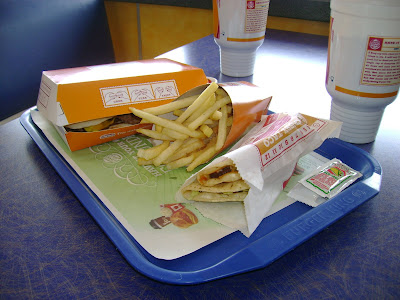
I know some of you must be asking yourself, "What does making tacos have to do with modeling or photography?" Well, let me tell you a short story. I guy goes into a burger joint and orders a couple of tacos. The server says, "Sir, this is a burger joint, we don't serve tacos." The guy then asks to speak to the manager, whereas the manager aped what the server said and told the gentleman, "Sir, this is a burger joint, we don't serve tacos." Upset, but not discouraged, the man said to the manager, "Sir, your sign says the customer is always right and you will do whatever to satisfy the customer. I would like two tacos." At that, the manager told the cook, to start making two tacos.
Sometimes we need to ask ourselves, are we busy making tacos at a burger joint? I have had tacos at Jack in the Box, as well as Burger King on the West Coast, and for whatever reason, they never compared to any of the taco stands that were in the area. Likewise, their tacos weren't even as good as their burgers. I am a fan of diversification. I believe that being diversified allows you to adapt to change, but I am also a fan of specialty. Being specialized allows you to persevere through chaos.
While it may be one thing for a model or a photographer just starting out to go out and try different genres, as you build more experience, it may be better for you to be known for doing ONE thing great than a lot of other things ok. When we think of Tyra Banks, as much fashion as is put on her reality series, ANTM, is she not known for being a Victoria's Secret model? One who specialized in lingerie? Or even for her covers on Sports Illustrated as a swimsuit model? While she has done more fashion runway shows than most of us have ever seen, that is what she is known for. She does a few things GREAT which allows her to branch out to do other things on a case by case basis.
To use sports, Tim Tebow, college football legend, is probably one of the most exciting football players in the league to watch. He can pass, he can run, he can even block and catch. The problem is that if I was fielding a team, there would probably be 3 players in every position that I would choose, because they are specialist at those positions.
I often ask models and photographers, what is YOUR specialty? What are you known for? What do you want to be known for? Are you the go to for swimsuit? Editorial? Bridal? Boudoir? Or any other fields of fashion and photography? Are you known for being the "extra" on set? If that is the case, there is nothing wrong with that, but be known for that. Remember there are awards given out for Supporting Actors too, not just the Lead.
Find your specialty and be great at it.
Model Monday:Frustration and Rejection
Model Monday: Taking a Bye
Model Monday: The Pressure to Perform
One of the things that I see affect most new models and photographers is a strong case of nerves or stage fright. Often, this can be for many reasons, but usually it's out of fear. It could be a fear of rejection, or a fear of doing something wrong, or even a fear of looking like an amateur. Whatever the reason, it can be overwhelming to the point of being crippling.

I remember growing up, doing like so many kids do when playing neighborhood basketball, and pretending that I was Michael Jordan, taking that last second shot at the buzzer to win it all. Or maybe it was ALWAYS the bottom of the Ninth, down three runs, with bases loaded, and 2 outs, waiting on an O and 2 pitch at the World Series. Or Fourth and Goal for the at the 5 yard line needing a touchdown for the win, and either throwing or making the catch to win the game. What do all of these scenarios have in common? They are all high stress situations. Situations that require a need to perform.
I often wonder how many times Whitney Houston sang the Star Spangled Banner before her performance in Tampa Bay at Super Bowl 25? Or how many buzzer beaters MJ or Kobe practiced daily? I wonder if Tiger Woods, out of those hundreds of balls he practices with every morning, pretends that some are a 60 foot putt to win the Green Jacket.
When I was in the military, we had a saying; "You train to fight and you fight as you train." When I played soccer, during practice we did "lightning" rounds of trying to press and offense or a defense in the last 5 minutes of the game. In football, we practiced the 2-Minute Drill. All of these things bring us to being able to do what is routine, in non-routine situations.
As a Model or a Photographer, I always encourage practice. Of course, it is great to be in front of and behind the camera as often as possible, but that may not be afforded to us. To my photographers, I tell them to grab their favorite stuffed animal and use that as a model. When they see a location, shoot the stuffed animal first and pose it or position it. See what the light is doing. See what THEIR lights are doing, or what the sun is doing at that time of day. This often makes the actual shooting on set so much easier, because the only variable at that point is now the model, and not the environment. If things change, it makes it easier to adapt and overcome.
For the Models, while your mirror is your closest ally, it will often lie to you by showing you only what you want to see. A majority of us now carry advanced mobile phones which can not only take photos, but capture video. Take 30 seconds or so, and see how many facial expressions you can make on command. Can you transition from them? Why not do a monologue for 15 seconds. Post it on your favorite Social Media Networking site, and have your friends and followers critique your performance as well. Not only will it build up your abilities as a model, but it will make you more confident on set and in frame.
As you can see, it's not just practice that is needed, but also the right kind of practicing. Getting ready for that situation; relieving the pressure to perform, and turning it into a situation that is routine. To this day, when I go flying, and I come in for a landing, I still verbally go through my check lists. The same way I do when I am at home, "chair flying" so that it is routine to me. I remember in flight school, walking around the living room with all kind of objects on the ground to simulate an airfield. Think of the pressure that is placed on you when you are trying to land a plane. In most movies, that is the climactic, chaotic event, but every day, pilots around the world make it seem easy. Everyday models and photographers around the world, do what you want to do, and make it seem easy.
Practice the moment, and then LIVE for the moment!
Model Monday: Is it Professional to be Friendly?
If we look at a lot of the old movies and television shows about fashion models and shoots, we often see the "diva" model, or the arrogant photographer, or the unbearable copy editor. Is this a case of art imitating life, or did somewhere life imitate art?
I ask this question, because in this age of digital cameras and social media, more and more models and photographers, are able to get a shot at "making it." While the numbers haven't changed in the statistics of the likelihood of being a top model, what has changed though is the road to getting there. Yes, things like portfolio and image quality matter; but is a journeyman resume now required in order to begin life as a model or a photographer? Does a model have to go to 20 casting calls and go sees to land one job? Does a photographer have to lug around another photographer's gear for 8 months in order to get a shot as a lead on a shoot? Or can a model/photographer make it to certain levels based on popularity and being the "hot commodity" at the time?
Social media is big, and I believe here to stay. For the first time in many industries, not only are consumers and sellers in direct communication, but bosses and employees, providers and clients, and yes, photographers and models, now find themselves in constant contact.
While on the surface, this can prove to be a GREAT benefit to a starting model or photographer, especially to build comfort, deep down, it can lead to a certain familiarity that may not be the best to have in a professional environment. Personally, I am a very friendly and open person. I like having chemistry with all those on set. But my military background has taught me how to separate colleague from friend, without making an enemy. Models know that they can usually approach me for advice and tips on many levels of things in and outside of the industry. Unfortunately, not everyone is like that these days. Some photographers and models have other motives besides shooting. Not to say they are nefarious, but to say that their intent and your own may differ. So let's start a discussion.
Some things I would like to ask you.
At what level does a potential model/photographer go from a person that you want to work with to needing a restraining order?
Does a Model or Photographer who is always dating other Models/photographers cause you to be cautious?
What are some signs that you would share with other models and Photographers to be aware of while conversing online?
I do not want this post to be an "outing" of any kind, but more so a discussion of a topic that seems to be trending in a bad direction these days. So what say you?
Model Monday: Compensation
Sometimes I think that this area of the industry, as well in many service industries, is the most confusing. Not just for models, but for photographers, Makeup Artists (MUAs), Hair Stylists, Wardrobe stylists, and other artists in the industry may find this equally confusing. In many contract negotiations, a level of compensation must be reached for consideration to take place. For instance, in a collaborative or trade situation, the "usual" compensation would often be for an MUA to provide makeup in order to receive a certain amount of images from a photographer of a model. Or the photographer, in order to shoot a model, may provide images to the model in exchange for his/her time. Or a model, in order to get better images in the model's portfolio might shoot a theme for a hair stylist in exchange for those images. All of these instances involve an exchange of services without the exchange of money.
When money is involved, the level of compensation is often considered equivocal. Meaning that if a model normally charges $100 per hour, and now charges $50, often it is because that model will still receive some kind of alternate compensation; this could be prints, wardrobe, or something else of value. All of these things are negotiable, but it is in the best interest of all parties concerned to understand what is going on, and the process involved.
If you are a model, photographer, MUA, Hair Stylist, etc., and you are charging your contract or "for hire" rate, it should be set and understood, that is your rate with no further compensation. If I go into a Barber Shop and pay $20 for a haircut, when I leave, all business is final. The barber is not looking for the video footage of the news interview I am doing that night. Now, if the barber knows that I am going on the news, he may offer a discount in exchange for news footage from the interview.
I bring this up, because as of late, I have seen a lot of confusion with models starting out, and even "support" vendors newly venturing in the industry. I want there to be an understanding that EVERYTHING IS NEGOTIABLE, and that what is laid out here is not set in stone, but more so, quick drying cement.
When you charge your full rate for services, the understanding is that you are fully being compensated.
Meaning that photographer, MUA, vendor, etc. does not owe you anything further. If a model is getting $5,000 for a photo shoot, AND receives unpublished/printed images, it usually is a courtesy, not a requirement. If the model desires images from that shoot, the model will have to seek out what is called a "tear sheet" of that shoot. So called, because usually if you saw it in a magazine or publication, in order for you to have it in your book, you would have to TEAR IT OUT of the publication.
This all goes back to the business side of modeling. In order to do well at business, there is a need to research the business. One of the quickest ways to separate yourself from a field of good photographers and artists, are to start off by making "uncommon and rare" demands. The other day I was talking to a beautiful model, who's images overall in her portfolio, do not match her ability and potential. After doing some research, found out that her demands were very uncommon and rare. Not only a demand to see all images from her shoots, but to require a copy of all images whether used or not AND a joint ownership of copyright, whether she was being paid for the shoot or not. It then dawned on me that her portfolio reflected the level of photographer who would agree to such terms. Often the photographer who is just starting out and do not know or understand things such as Copyright Law, or the photographer who will release images that are not the photographer's best out to the public domain.
One final thing, when I say uncommon and rare, it does not mean that this never happens. Celebrities that are shot often require a transfer of image ownership with some type of license/usage issued to the photographer or other participants. In those cases, the photographer and other participants are compensated for THEIR lack of ability to use images and usage. So while the terms themselves might be different, the end result of being compensated remains.
I recommend for all parties that are involved within the fashion and beauty industry to study the subject of compensation and deal with advisors who are familiar with the industry. This is not meant to be legal advice, but more so educational. There are lawyers out there who solely work in the fashion, beauty, and entertainment industry, who will often achieve terms in your best interest while maintaining a good working environment. Seek those sources out. The one thing that you don't want to stop your career, whether in front of the camera or behind it, is developing the reputation of being someone that others cannot work with.